Key Takeaways
- One workout gives your brain a small but real boost, mainly in focus, planning and self-control.
- In a trial of 85 adults, that boost was still there 2 hours after a single session.
- In older adults, a 30-minute morning walk lifted decision-making across a long day of sitting.
- Timing is the tool: move before the work that needs your best thinking, not after it.
I train before I start work, every day. Not because I have spare time, but because that hour is mine.
By the time I open my laptop, I've already done something hard. I feel sharp, I feel like I've accomplished something, and that carries me through the rest of the day. I have the mood and the energy to keep ticking things off.
I see the same thing in my clients. The ones who move first thing, whether that's a full training session or just a walk, tell me they feel more switched on and cope with their days better.
That could just be a feeling. So I went looking for what the research actually says.
The short answer
Yes, one workout does sharpen your thinking, and the effect can last up to about two hours. But it's a modest boost, not a superpower. It shows up most in the skills you use to focus, plan and make decisions.
What one workout does to your brain
The biggest summary of this research pooled 79 studies on single exercise sessions and thinking (Chang et al., 2012). Across all of them, exercise gave a small, positive effect. It showed up during exercise, straight after it, and after a delay.
The size of the boost depended on the details: how long and how hard people exercised, what kind of thinking was tested, and how fit they were.
A large review from neuroscientists at New York University pulled the evidence together (Basso & Suzuki, 2017). The skills that benefit most are the "executive" ones, run by the front of your brain:
- Attention: staying on one task.
- Working memory: holding information in your head while you use it.
- Cognitive flexibility: switching between tasks.
- Inhibitory control: ignoring distractions and resisting the urge to check your phone.
Mood improves too, often straight away. The same review notes mood benefits that may last up to about a day.
How long does the boost last?
This is where the "for hours" comes from.
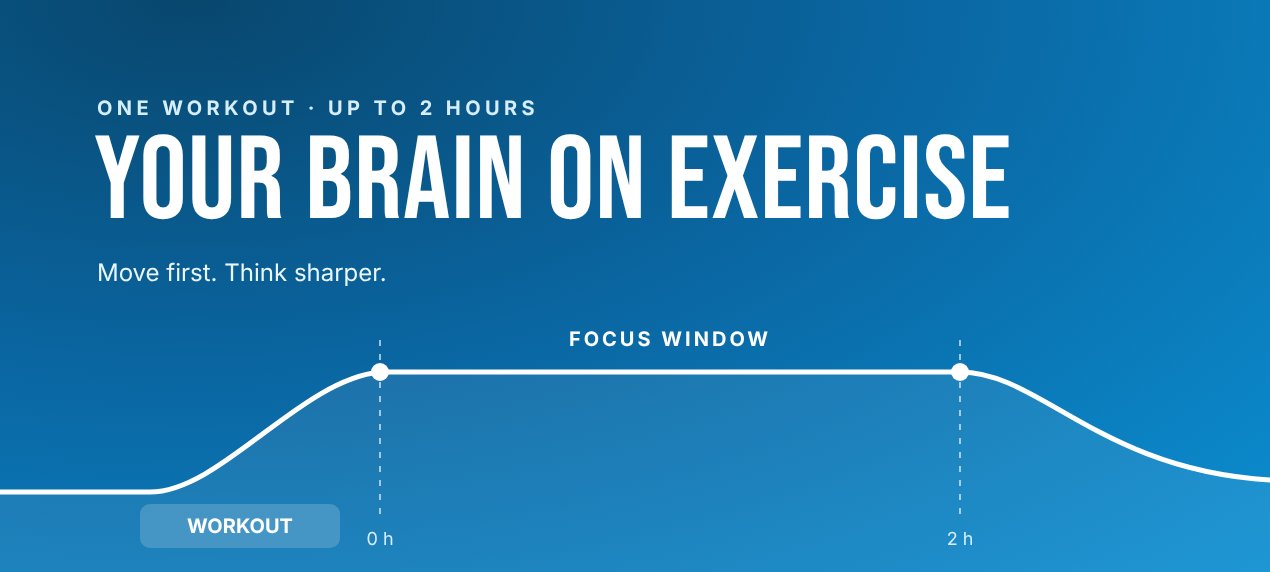
In a trial at New York University, 85 healthy adults either did one session of vigorous aerobic exercise or watched a video (Basso et al., 2015). They were tested 30, 60, 90 or 120 minutes later.
The exercisers did better on tasks that rely on the front of the brain, and the benefit was still there at 2 hours. Interestingly, memory tasks that depend on a different brain area, the hippocampus, didn't improve after one session.
The focus window after one workout
Why morning training works so well
One study tested almost exactly what I do with my mornings (Wheeler et al., 2020).
Researchers took 67 adults aged around 67 and had them sit for a long day, about 8 hours. On one day they just sat. On another, they did a 30-minute moderate walk in the morning first. On a third, they did the walk and also broke up their sitting with 3-minute light walks every 30 minutes.
The results:
- The morning walk protected decision-making skills across the day, compared with sitting all day.
- Adding short walking breaks also improved working memory.
- Levels of BDNF, a protein that helps brain cells grow and connect, were higher on both exercise days.
These were older adults, so we can't assume the same numbers for a 30-year-old. But it fits what I see: a morning session sets the tone for the whole day.
Does it work for kids too?
In a small study, 20 children walked on a treadmill for 20 minutes at a moderate pace, then took an attention test (Hillman et al., 2009). They were more accurate after walking than after resting, and they also did better on a reading and maths test.
It's one small study. But if you're a parent, a walk before homework is an easy experiment.
Why it happens
Scientists are still working out the details, and a lot of the evidence comes from animal studies. The main ideas:
- More alertness chemicals. Exercise raises noradrenaline, which helps you stay alert and focused.
- BDNF. Often called "fertiliser for the brain", it helps brain cells grow and connect. It rises after exercise.
- Better mood. When you feel better, it's easier to concentrate and keep going.
How hard and how long?
You don't need a brutal session. Benefits have been seen across a wide range of intensities, from a brisk walk to hard intervals. A few practical rules:
- 20–30 minutes is enough to make a difference. The kids' study used 20 minutes; the morning walk used 30.
- Moderate is plenty. You can talk but not sing (the talk test).
- Very long or exhausting sessions may leave you tired rather than sharp, especially if you're not used to them.
Three focus primers to try
1 · Morning session
30–60 min
Train before work: strength, a run, a class. Your sharpest hours start when you sit down.
2 · Brisk walk
20–30 min
Right before an exam, a big presentation or a block of deep work. Talk, but don't sing.
3 · Movement break
3 min every 30
If you sit all day, get up and walk. It adds a working-memory boost on top.
Whichever you choose, protect it like a meeting. If you want a structured plan for the gym side, The 3-Day Split gives you three focused sessions a week for 8 weeks, with an Excel tracker.
What the research doesn't show
- The effect is small on average. It's a helpful nudge, not a transformation.
- People respond differently. Fitness, sleep, stress and the type of task all matter.
- Most studies test people in a lab, often within an hour of exercise. Real workdays are messier.
- One session isn't the whole story. Long-term training has its own brain benefits, which I'll cover in my next brain post.
FAQ
Does exercise improve focus?
Yes, modestly. A single session improves attention and decision-making, with the biggest effects on tasks that use the front of the brain.
How long after exercise is your brain sharpest?
Benefits show up during and straight after exercise and, in one trial, were still there 2 hours later.
Is it better to exercise in the morning?
For focus at work, morning exercise means you get the boost when you need it. A morning walk improved decision-making across a long day of sitting in older adults. The best time, though, is the one you'll stick to.
Do I need to exercise hard?
No. 20–30 minutes of moderate exercise, such as a brisk walk, is enough to see an effect.
The bottom line
One workout won't make you a genius. But it sharpens the parts of your brain you use to focus, plan and resist distractions, and that boost can last up to about two hours. Move before the work that matters, and let your training do double duty.
Want help building training into a busy schedule? Book a Consultation and we'll plan it around your day.
Sources
- Chang YK, et al. (2012). The effects of acute exercise on cognitive performance: a meta-analysis. Brain Research, 1453, 87–101. PubMed
- Basso JC, Suzuki WA (2017). The effects of acute exercise on mood, cognition, neurophysiology, and neurochemical pathways: a review. Brain Plasticity, 2(2), 127–152. Full text
- Basso JC, et al. (2015). Acute exercise improves prefrontal cortex but not hippocampal function in healthy adults. Journal of the International Neuropsychological Society, 21(10), 791–801. PubMed
- Wheeler MJ, et al. (2020). Distinct effects of acute exercise and breaks in sitting on working memory and executive function in older adults. British Journal of Sports Medicine, 54(13), 776–781. Abstract
- Hillman CH, et al. (2009). The effect of acute treadmill walking on cognitive control and academic achievement in preadolescent children. Neuroscience, 159(3), 1044–1054. PubMed
This article is general education, not medical advice. If you have a health condition, check with your doctor before starting something new.
Train first, think sharper
The 3-Day Split gives you three focused gym sessions a week for 8 weeks, with an Excel tracker that shows your progress. Easy to fit before work.
See the 3-Day Split →