Key Takeaways
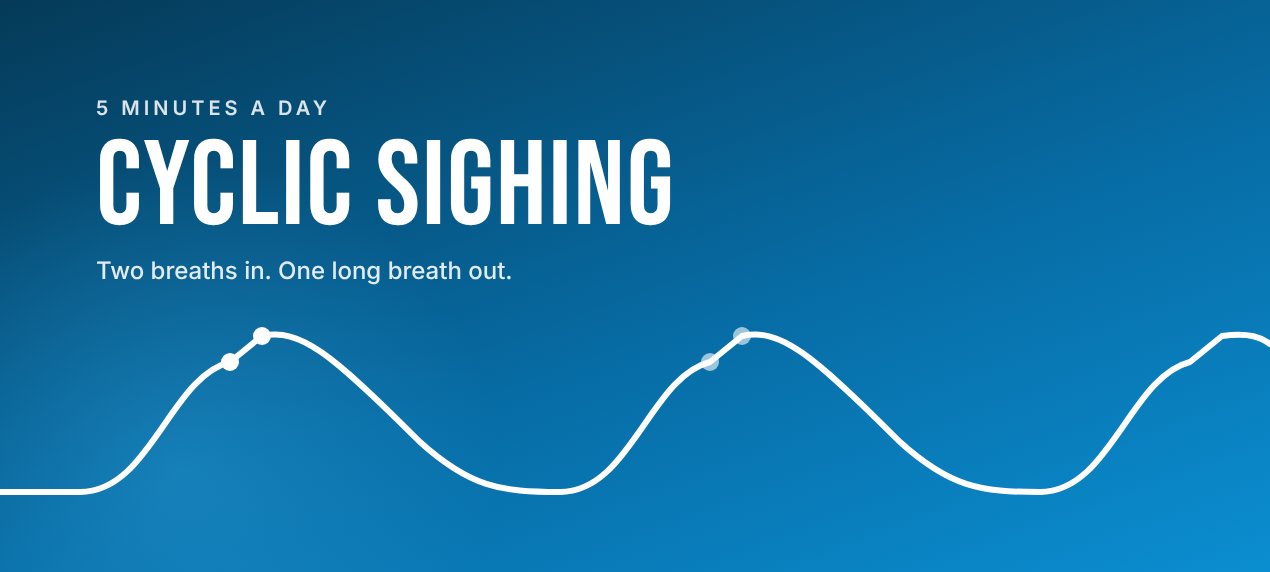
- Cyclic sighing is a double inhale through the nose followed by a long, slow exhale through the mouth, repeated for 5 minutes.
- In a month-long Stanford trial, 5 minutes a day of cyclic sighing improved positive mood more than 5 minutes of mindfulness meditation, and the effect grew the longer people kept it up.
- It also lowered people's resting breathing rate. Anxiety improved in every group, but no more with breathwork than with meditation.
- It's free, takes 5 minutes, and you can do it anywhere.
You already do this breathing exercise about 12 times an hour. You just don't do it on purpose.
On average, we sigh roughly every five minutes, usually without noticing. A sigh pulls in about twice the air of a normal breath. Researchers now think it does an important job: popping open the tiny air sacs in the lungs that slowly collapse when we breathe shallowly (Li et al., 2016). In mice, that study traced sighing to a small group of brainstem neurons. Block them, and the sighing stops.
Sighs may do something for the nervous system too. One study found that a sigh seems to "reset" breathing, bringing back a more regular, organised rhythm after a stretch of erratic breathing (Vlemincx et al., 2010).
So what happens if you sigh on purpose, for five minutes straight?
The Stanford study
In 2023, a team at Stanford tested exactly that (Balban et al., 2023). They split 108 adults into four groups, each doing one 5-minute practice every day for a month:
- Cyclic sighing: double inhale, long exhale.
- Box breathing: inhale, hold, exhale, hold, all the same length.
- Cyclic hyperventilation: fast, deep breaths with breath holds.
- Mindfulness meditation: sitting and passively watching the breath.
Everyone rated their mood and anxiety before and after each session.
What they found
- Taken together, the breathing groups improved positive mood more than the meditation group. On the mood scale, breathwork lifted positive mood by 1.91 points per session on average, compared with 1.22 for meditation.
- Cyclic sighing was the standout. It was the only practice that beat meditation clearly and whose effect kept growing with each extra day of practice.
- The breathing groups, and cyclic sighing in particular, also lowered people's resting breathing rate more than meditation did. The more someone's breathing rate dropped, the more their mood improved.
- Anxiety and negative mood fell in every group, including meditation. Breathwork wasn't better or worse on those.
| Practice | What you do | Mood lift per session |
|---|---|---|
| Cyclic sighing | Double inhale, long exhale | 1.89 points: clearly better than meditation, and grew over the month |
| Box breathing | Inhale, hold, exhale, hold, all equal | 1.84 points: higher than meditation, but not clearly different |
| Cyclic hyperventilation | Fast, deep breaths with breath holds | 1.97 points: higher than meditation, but not clearly different |
| Mindfulness meditation | Sit and passively watch the breath | 1.22 points: the comparison group |
This matches what I see in my own work. As a breathing coach, I use breathwork most with high-level professional athletes, executives and people in high-stress jobs. I teach it as a skill: a way to calm and control yourself in the moment. Slow breathing with long exhales works through the vagus nerve, the body's main "calm down" pathway, and that can help take the edge off stress and clear your head, so you make better decisions when it matters.
Why the long exhale matters
Cyclic sighing puts the emphasis on the exhale, which is longer than both inhales combined. Slow breathing with long exhales is closely linked to the "rest and digest" side of your nervous system.
A systematic review of slow-breathing studies (under 10 breaths a minute) found it was linked with higher heart rate variability, a sign of a calmer, more adaptable nervous system, and with people reporting less arousal and anxiety (Zaccaro et al., 2018). The authors are careful to say the evidence is still limited, and so am I. But the direction is consistent: slow down the exhale, and the body tends to follow.
How to do cyclic sighing
One cyclic sigh
- Sit or lie down somewhere comfortable. Relax your shoulders.
- Inhale through your nose until your lungs feel about full.
- Take a second, short inhale through your nose to top up the last bit of air.
- Exhale slowly through your mouth until your lungs are empty. Make the exhale longer than both inhales together.
- Repeat for 5 minutes. Breathe at whatever pace feels easy. There's no need to count.
If you feel light-headed, slow down or take a break. Simple as that.
When to use it
- When stress spikes: a work call that went badly, or being stuck in traffic. A few slow sighs are an easy way to pause and reset.
- Before a big moment: a match, a presentation, a heavy lift.
- After a hard training session, to help you switch off before you drive home.
- As a daily habit: the study used 5 minutes every day for a month, and the benefit grew with practice.
What the study didn't show
I like this study, but it's worth being honest about it:
- It was small, about 20–30 people per group.
- It was done remotely, so nobody checked how well people did the exercises.
- It wasn't registered before it started, which is the gold standard.
- It only lasted a month, so we don't know if the effects last.
- It found no change in heart rate variability, resting heart rate or sleep.
So think of cyclic sighing as a quick, free tool that seems to lift your mood, not a cure for anxiety or a replacement for proper help when you need it.
FAQ
Is cyclic sighing safe?
For most people, yes. It's gentle and slow. If you have a heart or lung condition, check with your doctor first, and stop if you feel dizzy.
Do I breathe through my nose or mouth?
In through the nose, out through the mouth is the most common way to do it, and nasal inhales make the short top-up breath easier to control.
How quickly does it work?
People in the study felt better after each 5-minute session, and the effect grew over the month.
The bottom line
Cyclic sighing takes 5 minutes, costs nothing and needs no app. In the best study we have, it lifted mood more than meditation did, and the benefit kept building with practice. Try it once today, then try it daily for a week and see how you feel.
Want to go deeper? Read Why Breathing Is a Performance Skill, Not Just a Reflex, or book a Consultation to build breathing into your training.
Sources
- Balban MY, et al. (2023). Brief structured respiration practices enhance mood and reduce physiological arousal. Cell Reports Medicine, 4(1), 100895. Full text
- Li P, et al. (2016). The peptidergic control circuit for sighing. Nature, 530, 293–297. Summary
- Vlemincx E, et al. (2010). Respiratory variability preceding and following sighs: a resetter hypothesis. Biological Psychology, 84(1), 82–87. Abstract
- Zaccaro A, et al. (2018). How breath-control can change your life: a systematic review on psycho-physiological correlates of slow breathing. Frontiers in Human Neuroscience, 12, 353. Full text
This article is general education, not medical advice. If you have a health condition, check with your doctor before starting something new.
Build breathing into your training
In a 1:1 Consultation we map your goals, your week and your stress, and build a plan that includes the right breathing tools for you.
Book a Consultation →
