Training Programs The Performance Program Coaching Plans Book a Consultation Stories About Blog Contact Book a Consultation

Jumper's knee program · 12 weeks

Fix jumper's knee without just resting.

A 12-week, 4-phase tendon loading program for pain just below the kneecap, written by a performance consultant who works with athletes. Clear tests tell you when to move on, so you're never pushed too fast.

  • 4 phases
  • 12 weekly plans
  • 4 gate tests
  • Excel tracker

126 AED (≈ US$34) · one-time · instant download

For adults with patellar tendinopathy and no swelling, locking or recent injury. Not sure what's causing your knee pain? Get it assessed first.

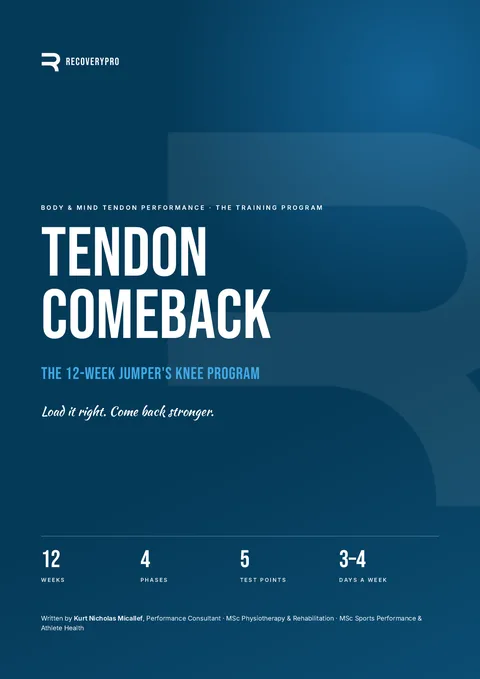
Cover of Tendon Comeback, a 12-week jumper's knee program by RecoveryPro

Rest calms it. Then it comes back.

Resting a sore patellar tendon eases the pain, so it feels like it's working. But rest also makes the tendon and quads weaker. Back to sport, the same load lands on a weaker tendon and it flares again: the rest–flare cycle.

Tendons get better with the right load, built up step by step. Tendon Comeback is that plan, written out week by week.

Why jumper's knee hangs around

01

Stopping completely

Weeks of rest lower the tendon's capacity, so the first busy week back sets it off again.

02

Stretching and massage only

They can ease how it feels for a while, but they don't build the strength the tendon is missing.

03

Jumping back too soon

Feeling better isn't the same as being ready. Without tests, it's a guess.

The method

Four phases. Four gate tests. One clear rule.

Tendon pain up to 3/10 during exercise is fine if it settles by the next morning. Every phase ends with a gate test, and you only move on when you pass it.

  1. Test your starting point

    A week 0 entry test and a red-flag screen: pain on a single-leg decline squat, hold times, strength of each leg and the VISA-P questionnaire.

  2. Load it, phase by phase

    3 to 4 sessions a week, each starting with an incline backwards treadmill walk. Holds, then heavy slow strength, then jumping, then your sport.

  3. Pass the gate, move on

    Every 3 weeks a gate test checks pain, strength and the difference between your legs. The Tracker colours it red, amber or green.

The four phases

Each phase has session pages, a page for every week, what to expect and a Mind task.

  1. Phase 1: SettleWeeks 1–3
    BodyIsometric holds incl. reverse Nordic, light slow strength, hips and calves
    MindPain makes sense
  2. Phase 2: BuildWeeks 4–6
    BodyHeavy slow resistance, single-leg strength
    MindShow up: habits and the flare script
  3. Phase 3: SpringWeeks 7–9
    BodyA 7-step jumping ladder, running build-up, heavy strength 2× a week
    MindTrust the spring: confidence ladder, landing imagery
  4. Phase 4: PerformWeeks 10–12
    BodySprints, cutting, sport-specific jumps, back to full training
    MindBack in the game: routines and a stay-strong plan

Evidence-based: built on progressive tendon loading with a 3/10 pain limit and 12 weeks of heavy slow resistance, the approaches with the best support in current research. References are in the Guide.

Safety built in: a red-flag screen, a traffic light for every session, a next-morning pain check, a flare-up plan and a route for when you're stuck at a gate. No program can guarantee results, and this one doesn't claim to.

What's inside

PDF · 22 pages

The Guide

How tendon pain works, the traffic light and flare-up plan, an exercise library, every phase, how to do each test, the Mind track and the VISA-P and TSK-11 questionnaires.

PDF · 30 pages

The Training Program

Every session with sets, reps, tempo and rest, a load log, and one page per week with targets, gate tests, what to expect and your check-in. Tap any week on the contents page to jump to it.

Excel

The Tracker

Type in both legs' results and get an automatic % difference score in red, amber or green, plus your weekly log, check-ins and questionnaire scores with charts.

Equipment: a gym with a leg press, leg extension and treadmill is ideal. Home swaps are included (bands, dumbbells, a step and a slope). Sessions take 35 to 50 minutes.

Is it right for you?

It's for you if

  • You have pain in a small spot just below the kneecap, worse with jumping, squatting or stairs
  • You play basketball, volleyball, padel, football or another jumping or running sport
  • You've tried rest and it keeps coming back
  • You're a physio or coach who wants a structured, test-based plan for clients

It's not for you if

  • Your knee is swollen, locks, catches or gives way
  • The pain started with a fall, a twist or a single landing
  • You have night pain or feel unwell (get it assessed first)
  • You're under 18 or still growing (pain below the kneecap can be a growth-plate issue)
Kurt Micallef, performance consultant and founder of RecoveryPro

Who wrote it

Written by a performance consultant who works with athletes

Kurt Nicholas Micallef is a performance consultant with 15+ years across physiotherapy, strength and conditioning and elite sport.

MSc Physiotherapy & Rehabilitation · MSc Sports Performance & Athlete Health · BSc Sports Therapy

"Most people with jumper's knee are told to rest. I built Tendon Comeback to do the opposite: load the tendon the right way, test it, and get you back to your sport with the numbers to prove you're ready."

Kurt

Jumper's knee program · 12 weeks

Tendon Comeback

126 AED≈ US$34 · one-time
  • The Guide, the 12-week Training Program and the Tracker
  • Clickable contents: jump to any week in one tap
  • Instant download, yours to keep
  • Written by a performance consultant with a physiotherapy background
  • Instant download · 2 PDFs + Excel tracker
  • Questions before you buy? hello@rprecoverypro.com, reply within 24 h

Inside Tendon Comeback

The 12 weeks at a glance page from the Tendon Comeback Guide: four phases and their gate tests
The 12 weeks at a glance
A training week page from the Tendon Comeback Training Program
A full training week
The clickable contents page of the Tendon Comeback Training Program
Jump to any week

Bundle & save 15%

Tendon Comeback + ACL Stay Strong

318 AED375 AED · save 57 AED · one-time
  • Both programs: fix the tendon, then keep both knees strong for the year ahead
  • 6 files: 2 Guides, 2 Training Programs, 2 Trackers
  • Instant download, yours to keep

Inside ACL Stay Strong

The year at a glance page from ACL Stay Strong
The year at a glance
A training week page from ACL Stay Strong
A full training week
The clickable contents page of ACL Stay Strong
Jump to any week

Not sure it's jumper's knee, or want Kurt to adapt the plan to your sport? Book a Consultation (250 AED).

Bundle & save 15%

Pairs well with

Add and get both programs for instead of

    You save · one checkout · all files emailed to you

    Questions

    How do I know it's jumper's knee?

    Patellar tendinopathy usually hurts in a small spot just below the kneecap, worse at the start of jumping, squatting or stairs, and often stiff the next morning. The Guide has a red-flag screen. If you're not sure, or your knee swells, locks or gives way, get it assessed before you start.

    Can I keep playing my sport?

    Usually yes, if the knee stays green on the traffic light. In the first phases you'll cut jumping and sprinting by about half, then build back up in phases 3 and 4.

    How long does it take?

    12 weeks if you pass every gate first time. Some people need to repeat a week or two, and that's built into the plan. Sessions take 35 to 50 minutes, 3 to 4 times a week.

    Do I need a gym?

    A leg press, leg extension and treadmill are ideal. Every key exercise has a home swap using bands, dumbbells, a step and a slope.

    What if it flares up?

    The Guide has a flare-up plan: ease off, don't stop. Most flares settle within a few days when you drop the load by a third. Red flags tell you when to stop and get checked.

    Is there a bundle?

    Yes. At checkout you'll be offered Tendon Comeback + Powerful Glutes for 239 AED instead of 282 AED, and there's a Tendon Comeback + ACL Stay Strong bundle on this page for 318 AED instead of 375 AED.

    How do I get it?

    Right after payment you get the download links on screen and by email: the Guide, the Training Program and the Tracker. Both PDFs have a clickable contents page. They're yours to keep.

    Can I get a refund?

    As a digital download, all sales are final. You can look at sample pages before you buy ("Peek inside"), and email hello@rprecoverypro.com with any question first. We reply within 24 hours.

    Not ready yet? Get the free Tendon Loading Guide first.

    Tendons don't need rest. They need the right load.

    Tendon Comeback provides general training and education. It is not medical advice, diagnosis or an individual prescription, and it does not replace an assessment by a doctor or physiotherapist. No program can guarantee results. Stop and seek help if something feels wrong.